Hou5eMoney
Make your job optional · a skill, a score, a second income

Your trading desk.
One login. Free for 7 days.

Stop jumping between charts, news, spreadsheets and five different tools. Hou5eMoney puts the pieces in one place: live charts, a 1-to-10 score on any setup, trade ideas with the entry, stop and profit target already written, the filings read for you, and a paper account that grades your discipline.

$0 today · then $29.99 a month, less than a dollar a day · cancel any time in the first week and you pay nothing
What would the desk do on…Type any stock. Three free reads a day, no account.
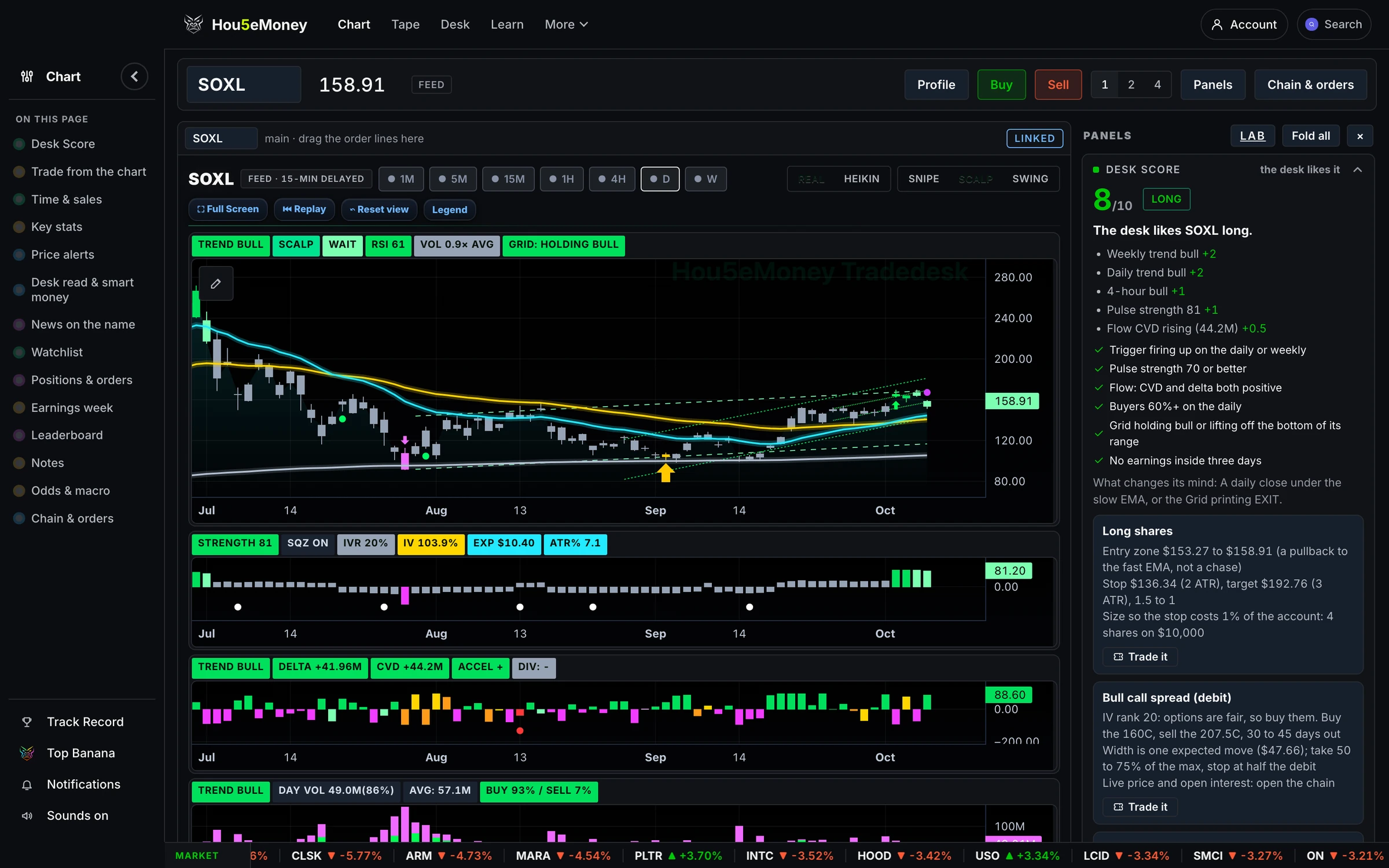
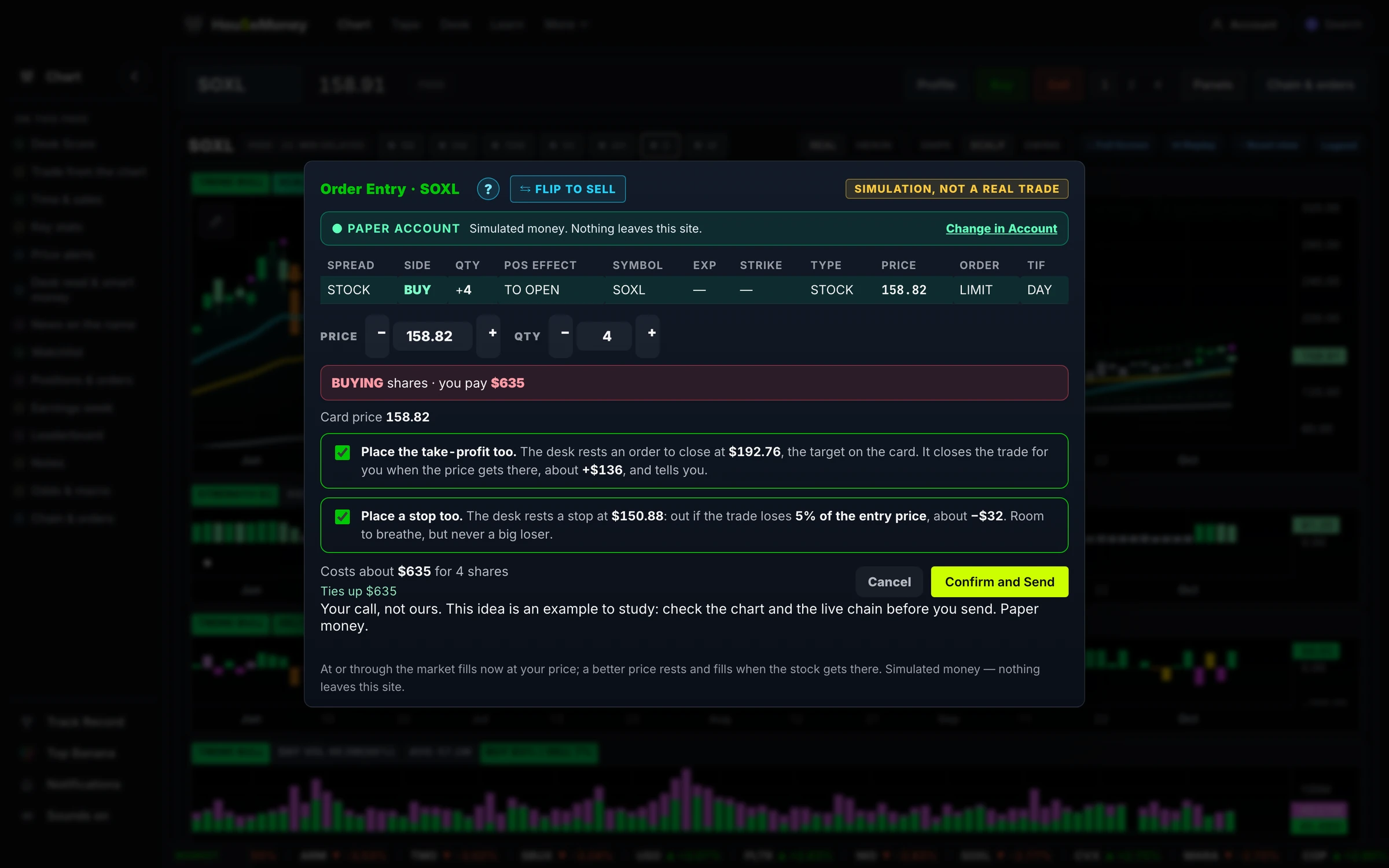
The Chart station: live candles on SOXL with the five-indicator stack and the Desk Score The order ticket filled in from the idea, stop and take-profit checked The Tape: a board of trade ideas with the plan written out The Desk: the paper account and the Discipline Rating The Congress Trades board The six free courses

Live charts with the five-indicator stack, on any symbol you type.

Real screens, captured Oct 8, 2026. Not mockups.

01 · CHART SMARTER

Five indicators on any live chart.

Trigger, Pulse, Flow, Grid and Tide read the same chart from five angles: the trend, the strength, where the money is flowing, the range, and who is in control of the volume. Six timeframes, the option chain, time & sales and the odds market sit beside it, on any US symbol you type.
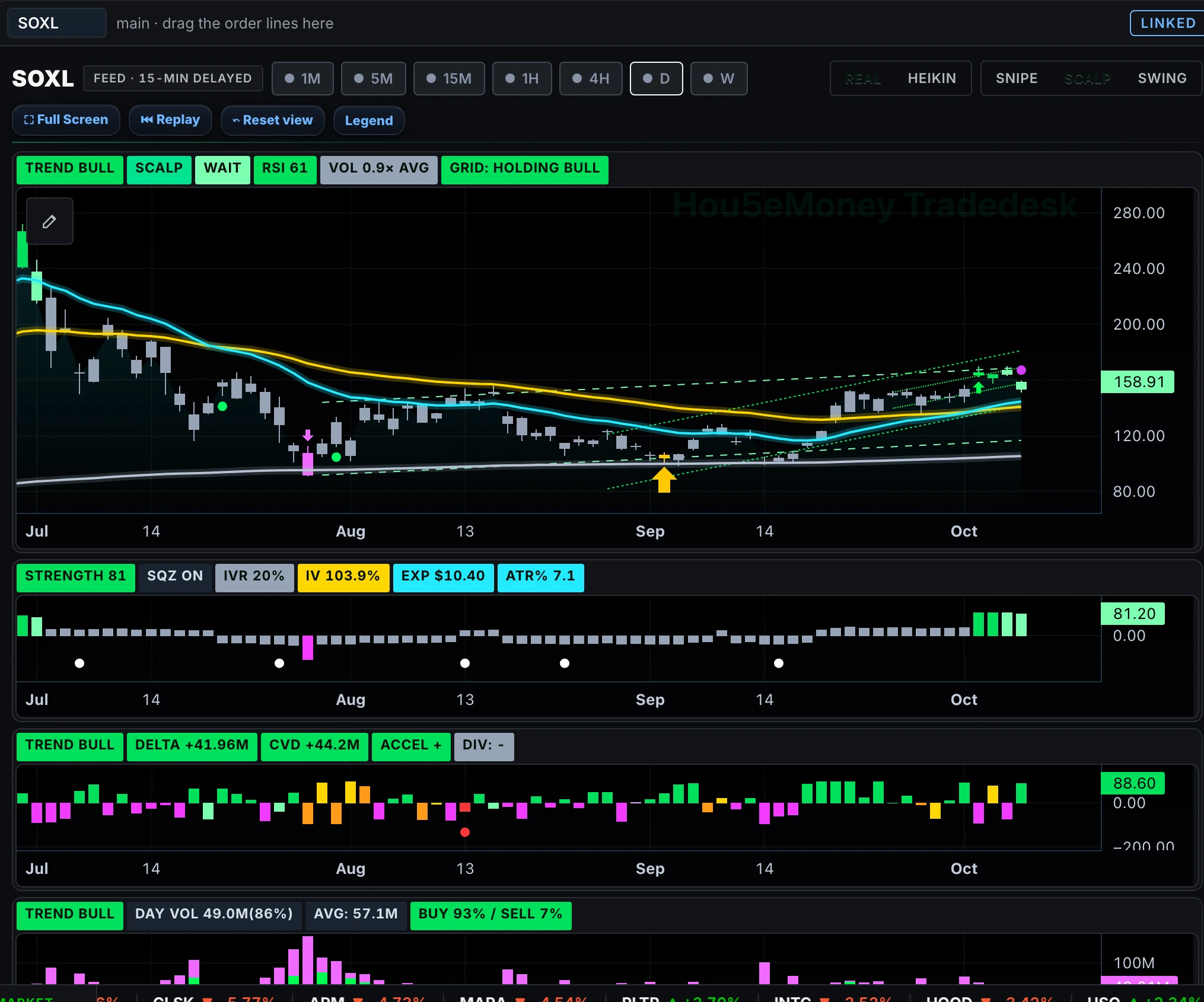
  • Candles move with the tape; a fresh arrow, dot or trend change prints as it happens
  • Buy and sell from the chart into your paper account; drag the stop and target lines
  • Every pane explained in plain English on hover, and in the free Chart reading course
The four-pane chart on SOXL, daily: Trigger, Pulse, Flow and Tide
02 · A SECOND SET OF EYES

The desk scores any chart 1 to 10.

Type a symbol and the desk reads the trend on four clocks, the trigger, Pulse, Flow, Tide, the Grid, earnings and the calendar. It adds the points, names the direction, and only says “take it” when six boxes are ticked. Every point is listed, so you learn the read while you use it.
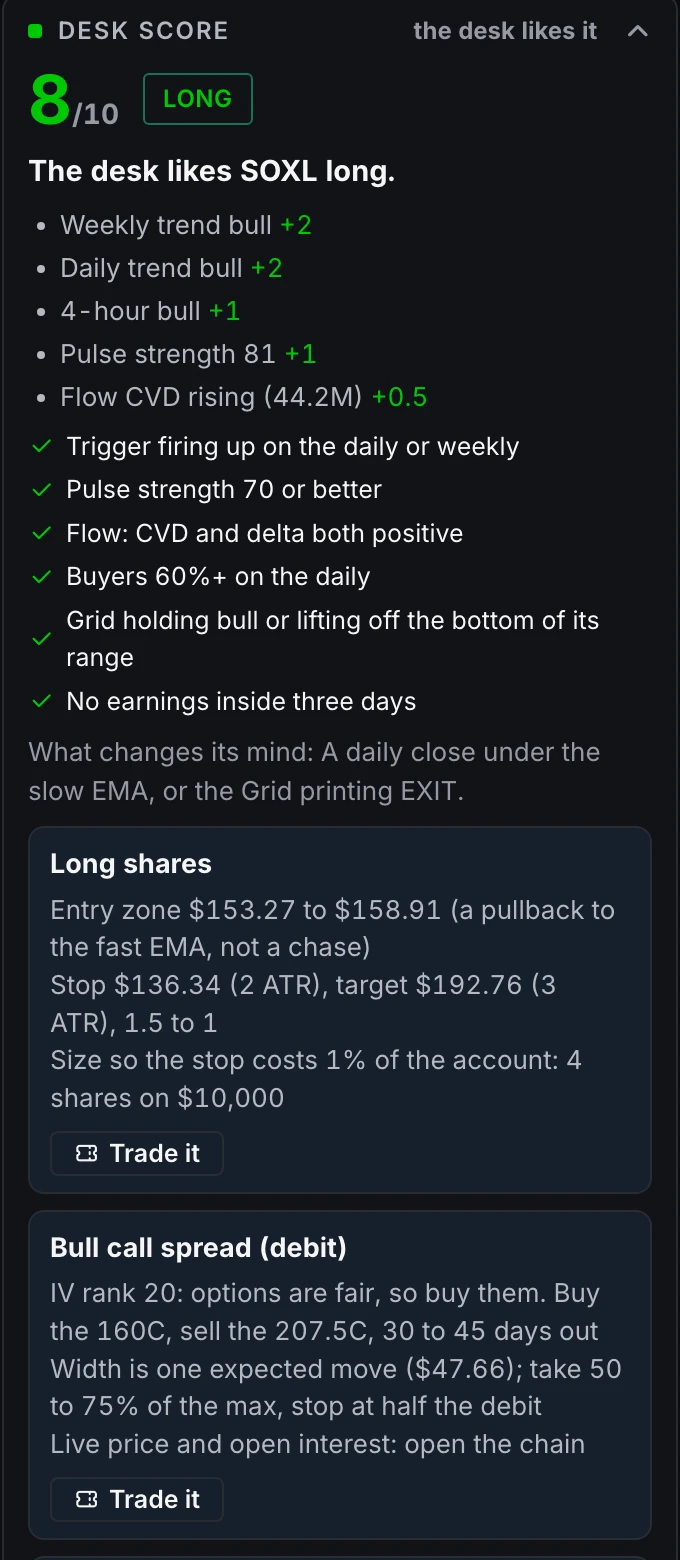
  • Three ways to approach a trade it likes: shares with a stop and target, a spread chosen by IV rank, a single
  • What would change its mind, in one line
  • No black box: the same five indicators you can see on the chart
The Desk Score panel: 8 of 10, long, six boxes ticked, three ways to trade it
03 · THE PLAN, ALREADY WRITTEN

Every morning, a short list with the entry, stop and target on it.

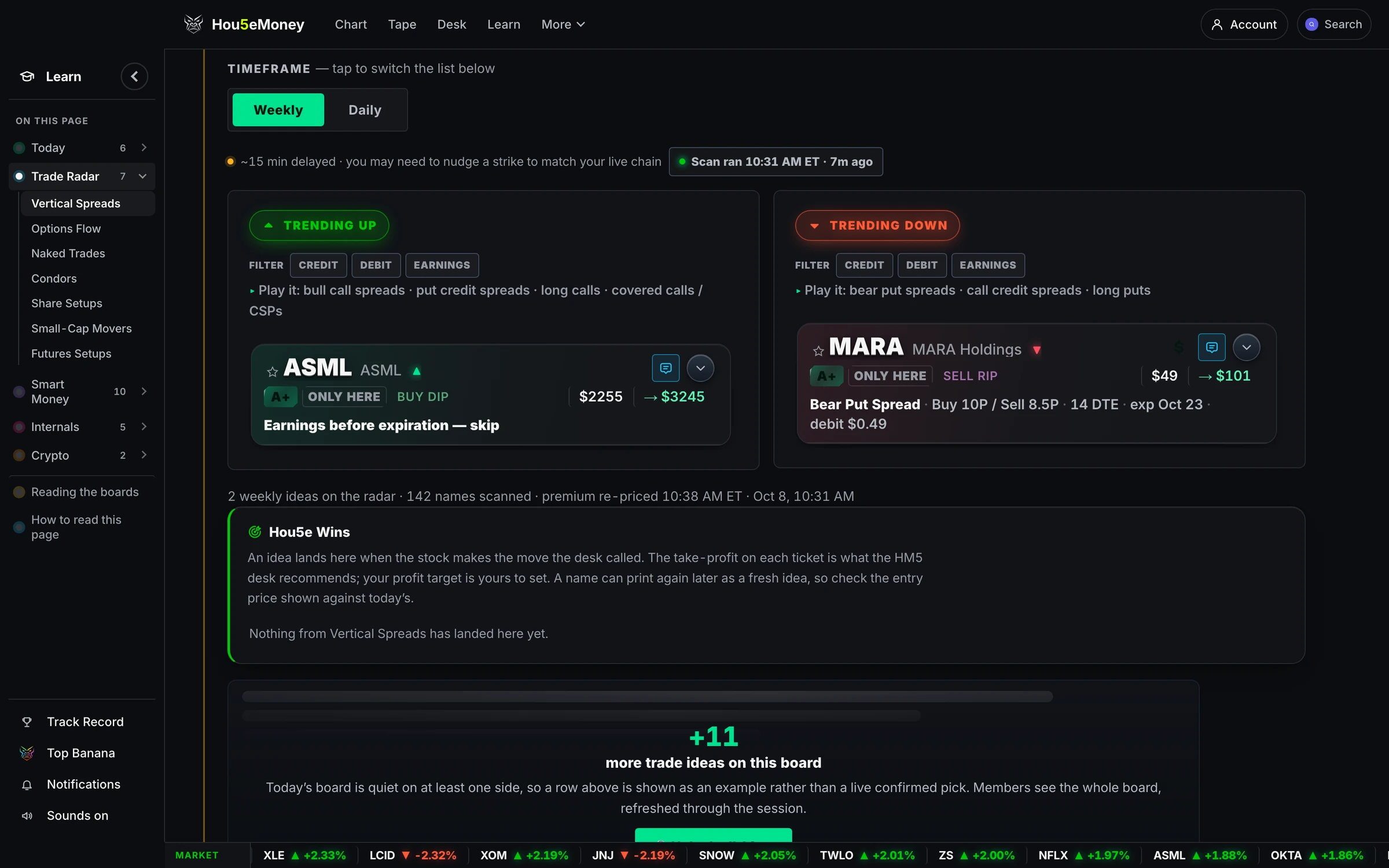
An idea prints on the Tape only after a trigger fires. Each card carries the structure, the strikes, the entry zone, the stop and the profit target, worked out from live prices. Tap Trade it and the order ticket is filled in with the stop and the take-profit resting as orders.

  • Spreads, single options, shares, small caps, futures: a board for each
  • You check it, you decide, you press send. The desk did the arithmetic.
  • Paper account today; the same ticket copies out for your broker when you are ready
One idea card on the Tape, with the direction, the cost, the target and the desk's note
The order ticket, filled in from the idea, with the stop and take-profit checked
04 · PRACTICE WITH REAL PRICES, NOT REAL MONEY

A paper account that grades your discipline.

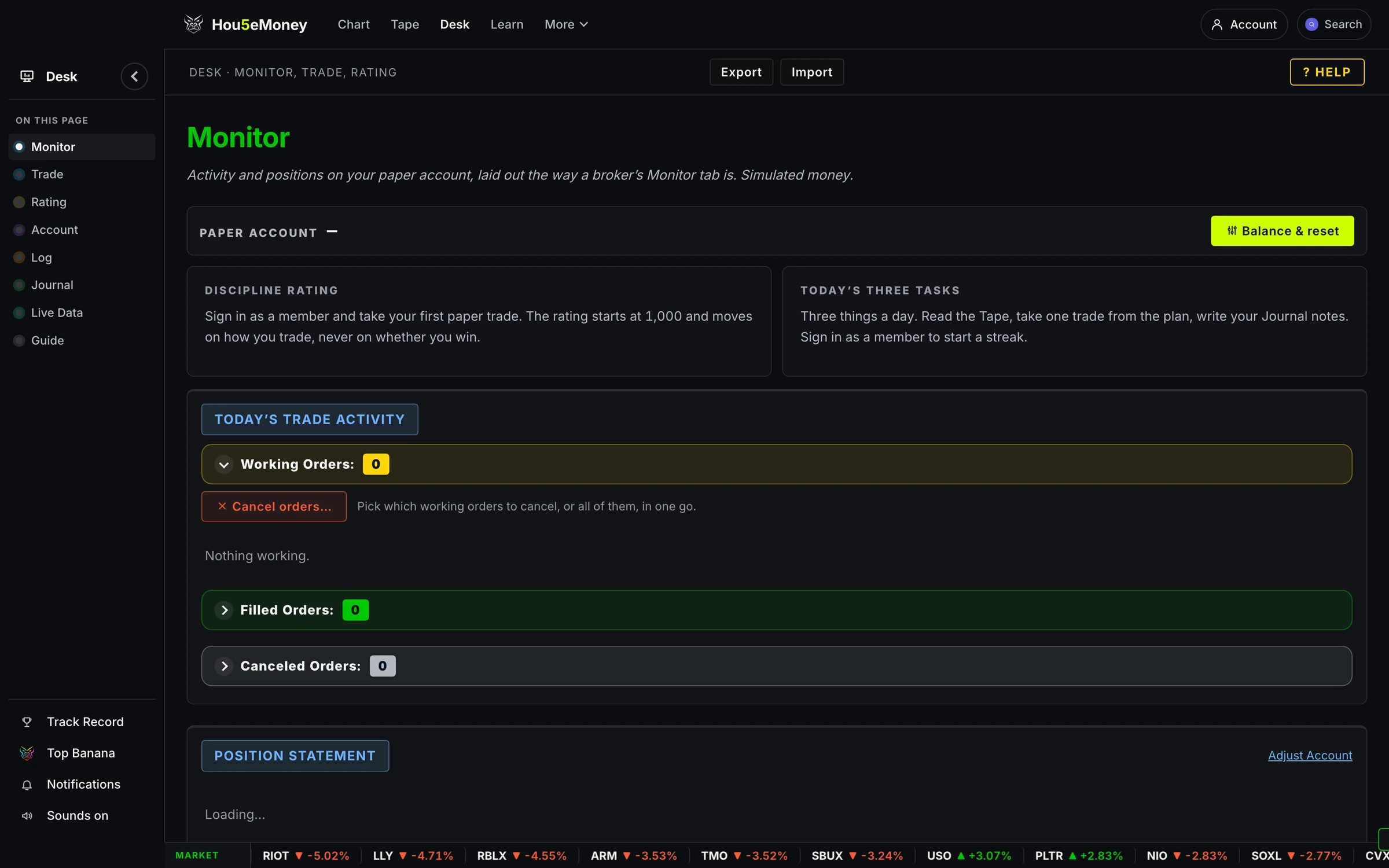
Your paper trades fill at real prices, mark to the market, and rest their stops and targets like a broker would. The Discipline Rating does not care whether a trade won. It grades six checks: the right grade, the right size, the exit set, and so on. Six for six scores even on a loss.

  • Nothing real is ever bought or sold here; real money only if you ever connect a live account
  • A notice the moment an order fills, hits its target or stops out
  • When the score says you are ready, you are
The Desk: the paper account, the Discipline Rating and today's trade activity
05 · YOUR WEEKLY REALITY CHECK

A journal that writes your review.

Three lines after every trade: what you saw, what you did, what you would do again. Every week the Journal reads your closed trades and writes the review for you: what worked, what leaked, and one rule for next week. Nobody reads your trades but you.

What a weekly review looks like

What worked: four of five A+ ideas taken in the entry zone hit their target.

What leaked: two chases at the open, both stopped out; sizing ran over 10% once.

One rule for next week: no entry outside the zone on the card.
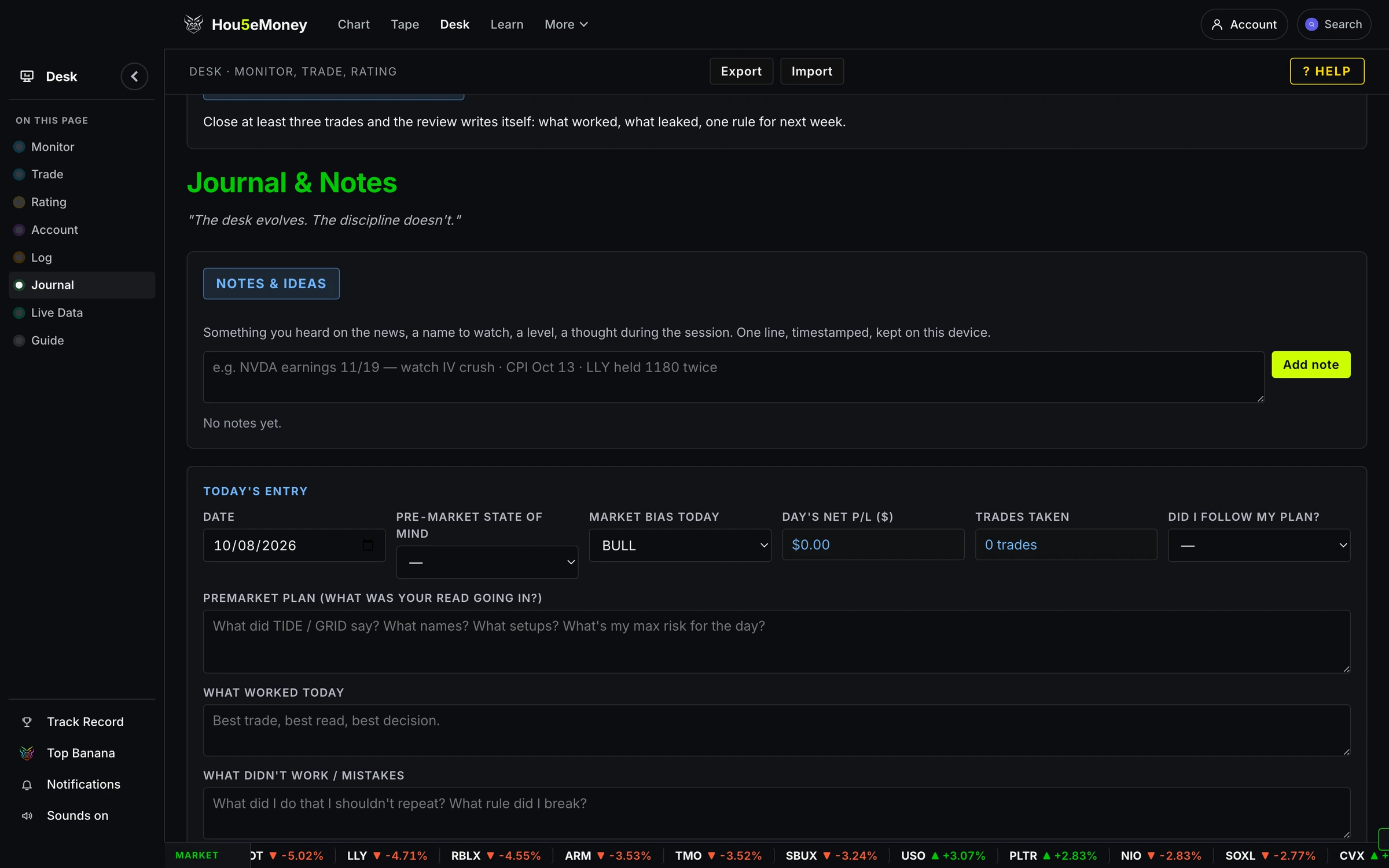
The Journal and notes
06 · EVERY IDEA PUT TO THE TEST

The desk takes every idea, losses included.

Every idea the boards print is taken by the desk’s own ledger in a paper account, with the stop and target the card gave it, and logged when it finishes. Twenty rule-book bots replay the same trades with different rules in the Bot Lab, so you can see which rules work and which leak money before you risk a dollar.
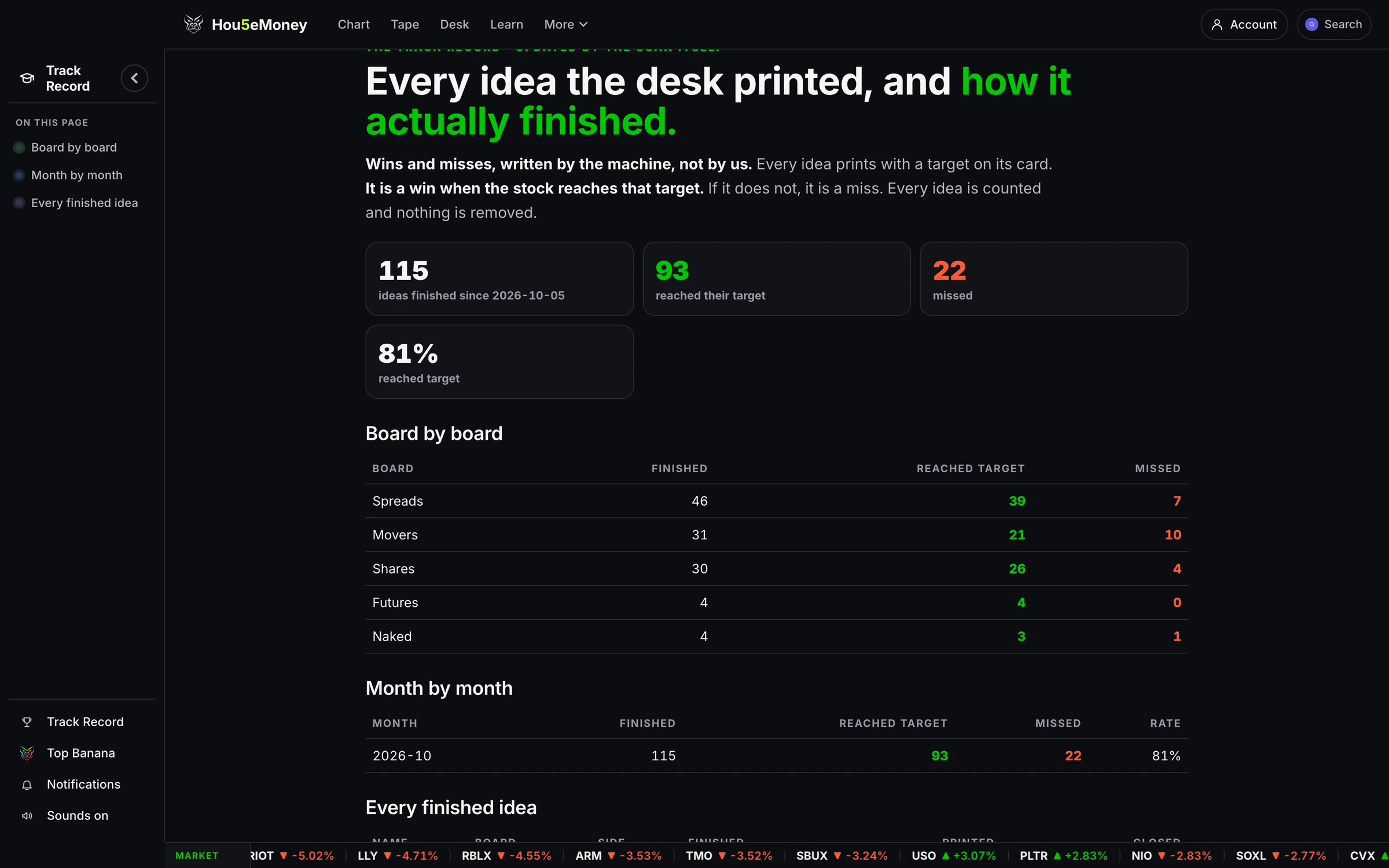
  • The public record: every finished idea, wins and misses, nothing deleted
  • A weekly leaderboard for members, with a challenge
  • Study how it is done with nothing real at risk, then do it yourself on paper

Read the record →

The public record page
07 · BEHIND THE TICKER

The filings, read for you.

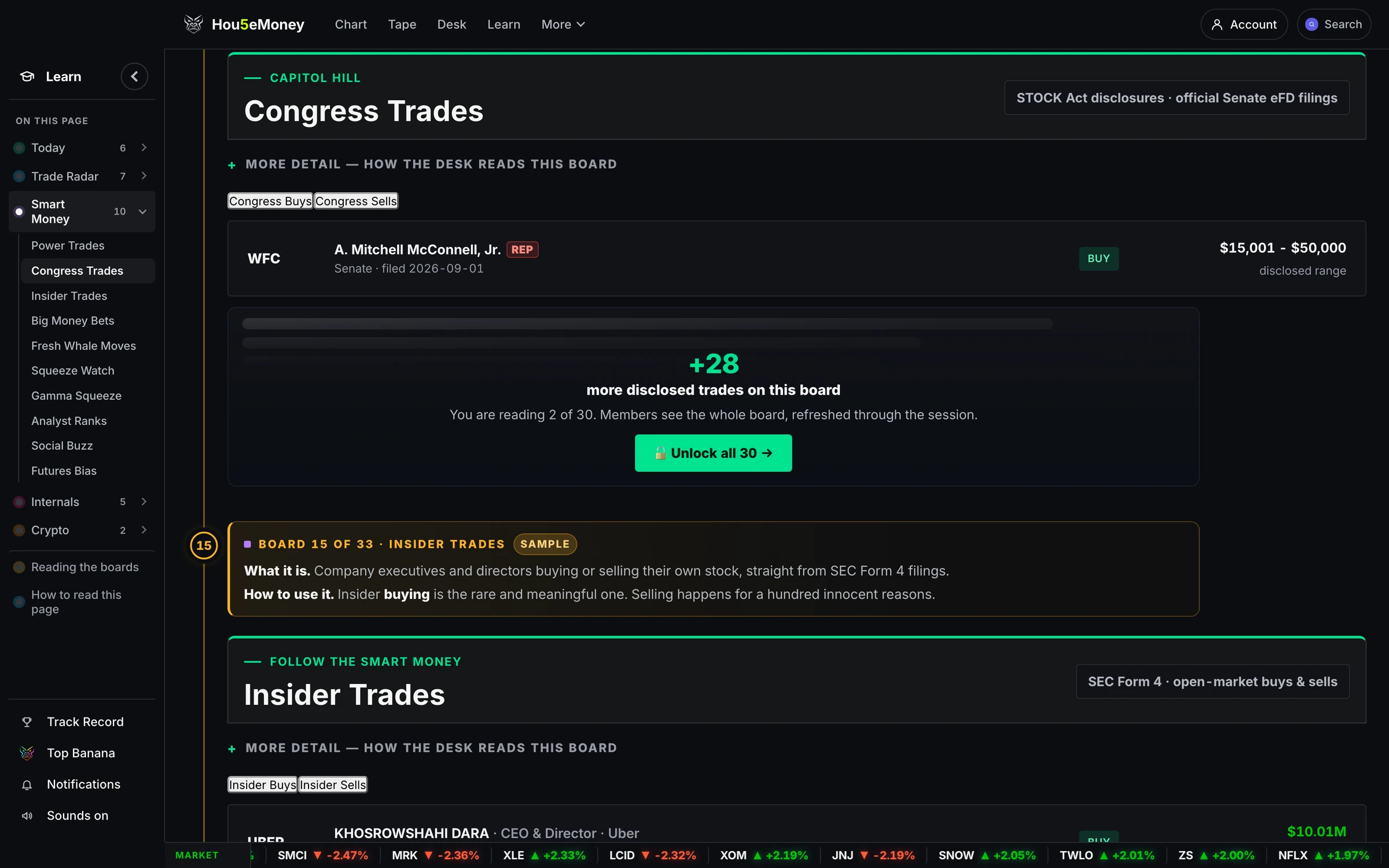
Congress disclosures, executives’ Form 4s, the biggest funds’ 13Fs, activists’ new stakes, foreign governments: the desk reads them every day and lays them out as facts with the filing linked. Beside each name, what the desk’s chart says today and where it would enter.

  • Who bought what, and when it was reported
  • Options flow, gamma walls, squeeze watch, sector rotation, the week ahead
  • Facts with a source, no side taken
The Congress Trades board: who filed what, when, with the filing
THE CREED · TEN RULES, ONE DISCIPLINE
  1. 01Trade with the trend. Never against it.
  2. 02If any dashboard says CHOP, the answer is no.
  3. 03Two indicators disagree, no trade.
  4. 04Read IV rank before you pick a structure.
  5. 05Define the max loss before the entry.
  6. 06Size for the loss, not the win.
  7. 07When the exit prints, close or roll.
  8. 08The chart owes you nothing.
  9. 09Paper money first. Always.
  10. 10If you did not follow the rules, it was not the system that lost.

The whole Creed, in the Playbook →

THE WHOLE DESK · ONE MEMBERSHIP

Stop paying for one feature at a time.

A professional terminal runs about $2,665 a month. A chart site alone is about $60. A Congress tracker alone is about $30. Hou5eMoney is $29.99 for all of it, less than a dollar a day, and the first seven days are free.

Terminal
One chart site$60 / mo
Hou5eMoney, all of it$29.99 / mo

You bring the decision. The desk does the heavy lifting. No guru required, no complicated setup. Paper money first; real money only if you ever connect a live account.

Hou5eMoney Pro · the complete trading desk
$29.99 / month
  • The Chart station, live
  • The five indicators, any symbol
  • The Desk Score and three ways to trade it
  • The Tape and every board
  • The paper account, the Journal, the Rating
  • The Bot Lab and the leaderboard
  • The live room and the Community
Start my 7-day free trial →

Card required, $0 today. Cancel any time in the first week from your Whop account and you are never billed.

NOT READY TO TRADE YET?

The six courses are free forever.

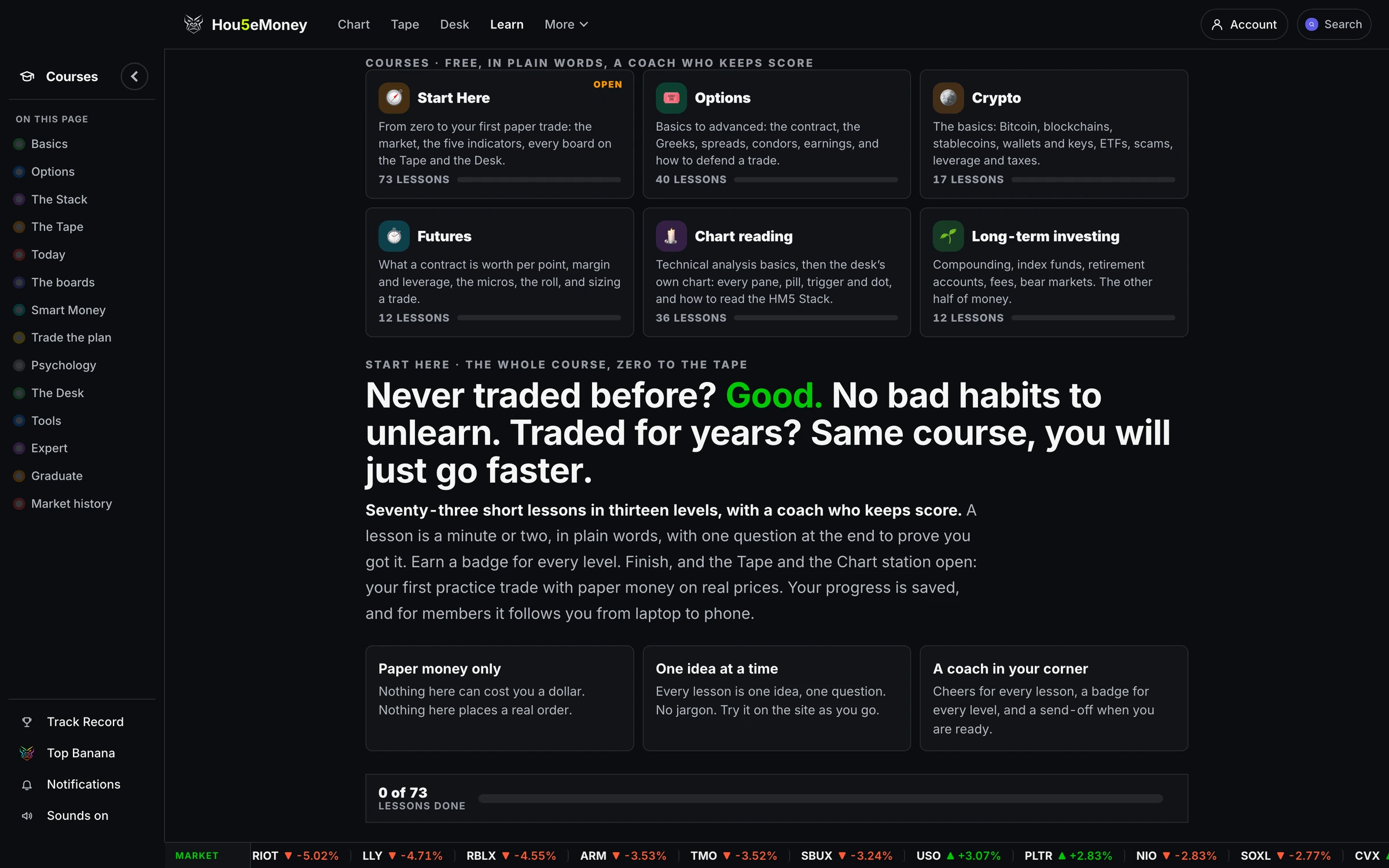
Start Here is seventy-three short lessons, about a minute each, from “what is a share” to reading the desk’s chart and placing your first paper trade. Then Options, Crypto, Futures, Chart reading and Long-term investing. No account, no email. Ten real charts a day to call on Play, free too.

The six free courses
Does the site place real trades?

No. Every order here fills a paper account. If you ever connect a live account, the ticket copies out for your own broker and you place it there.

Is this advice?

No. It is education and paper trading. The ideas are examples to study: the desk shows its work so you can learn the read and make your own decisions.

What happens after the 7 days?

$29.99 a month, the founding rate, locked in for as long as you stay. Cancel any time from your Whop account: one click, no email, no call.

Do I need to know anything first?

No. Every word is explained the first time it appears, Learn mode explains any button on hover, and the free course starts from “what is a market”.